Bangkok Travel Guide
Arriving in Thailand 2026: The TDAC Card

Landing in Bangkok for the first time can feel like being thrown in the deep end: a huge airport, a new language, and — since 2025 — a mandatory online form most people have never heard of. This guide walks you through everything from the TDAC arrival card to stepping into your ride, so nothing catches you out.
What is the TDAC (Thailand Digital Arrival Card)?
The Thailand Digital Arrival Card (TDAC) replaced the old paper TM6 arrival slip. Since 1 May 2025, almost every foreign visitor must complete it online before arriving in Thailand. It is free, and it is done on the official Thai Immigration website — not through any paid third party.
You should fill it in within 72 hours before your arrival. You’ll need:
- Your passport details
- Flight number and arrival date
- Where you’re staying the first night (hotel name and address)
Once submitted, you receive a QR code. Save it to your phone or take a screenshot — immigration may ask to see it. That’s the single most important thing to do before you fly.
Tip: fill in the TDAC on the plane’s Wi‑Fi or at a lounge before you land, so you’re not scrambling for signal in the immigration queue.
Step by step: from touchdown to your hotel
1. Immigration
Follow the “Arrivals” and “Passport Control” signs. Have your passport and TDAC QR code ready. Queues at Suvarnabhumi can be long after a bank of long‑haul flights land together — allow time if you have an onward connection.
2. Baggage & customs
Collect your bags, then walk through the green “nothing to declare” channel unless you’re carrying goods over the duty limits.
3. SIM card or eSIM
Booths from the main Thai networks are right in the arrivals hall. A tourist data SIM is cheap and makes everything else — maps, Grab, WhatsApp — far easier. An eSIM bought before you fly saves even that step.
4. Money
ATMs and currency exchange are in arrivals. Airport exchange rates are poor; change just enough for the first day and use in-town exchange booths or ATMs afterward. Most transfers and many shops take cash (Thai baht); cards are common but not universal.
5. Getting to your hotel
This is where first-timers most often get stung. The public taxi rank uses a queue-ticket system, but drivers sometimes refuse the meter, “forget” the tolls, or quote a flat inflated night rate. Ride-hailing apps work but surge when lots of flights land at once.
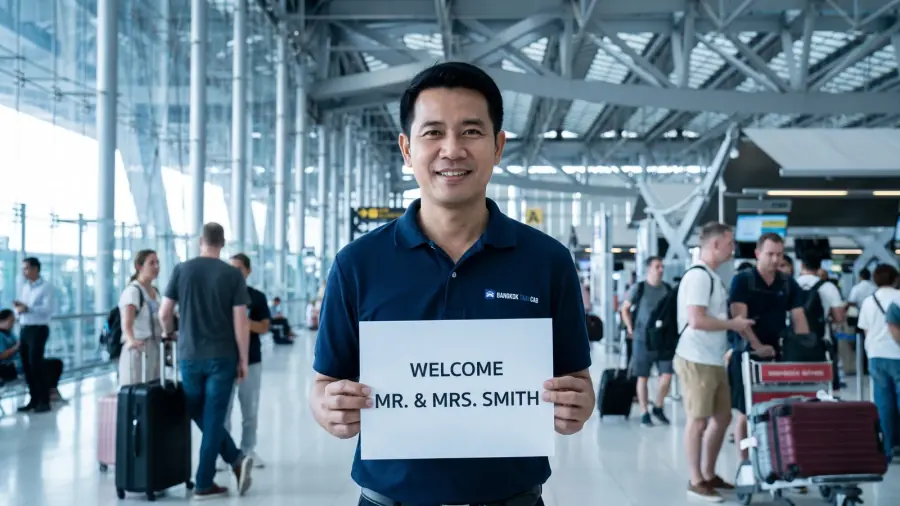
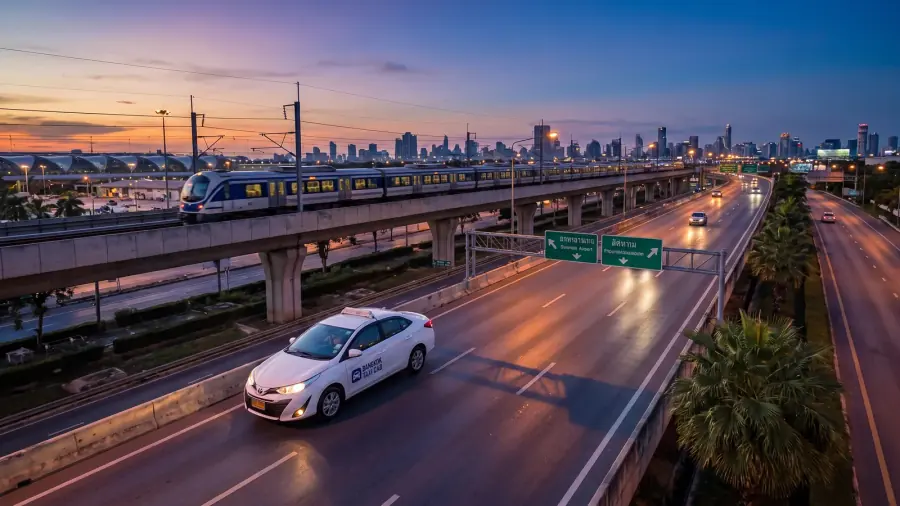
A pre-booked fixed-price transfer removes the guesswork: you agree the fare before you fly, your driver waits inside arrivals with your name on a board, and you go straight to your door. If you land late, tired, or with a family and luggage, it’s the least stressful option — see our Suvarnabhumi airport transfer and Don Mueang airport transfer pages for fixed fares.
Which airport are you landing at?
Bangkok has two: Suvarnabhumi (BKK), the main international hub to the east of the city, and Don Mueang (DMK), the older airport to the north used mostly by low-cost and domestic flights. They are about an hour apart, so if you have a connecting flight between them, plan the transfer carefully — read Suvarnabhumi vs Don Mueang for the full picture.
Heading straight to the coast?
Plenty of visitors skip Bangkok entirely and go straight to the beach. Rather than change to a bus in the city, we drive direct from either airport to Pattaya, Hua Hin or Koh Samet at one fixed price — luggage, kids and all.
Quick arrival checklist
- ✅ TDAC submitted online (QR code saved) within 72h of arrival
- ✅ Passport valid for at least 6 months
- ✅ First-night hotel address written down
- ✅ SIM/eSIM sorted for data
- ✅ Airport transfer pre-booked so someone’s waiting for you
Get those five right and your Thailand trip starts the moment you land — not in a taxi-rank argument.